Ahruskians
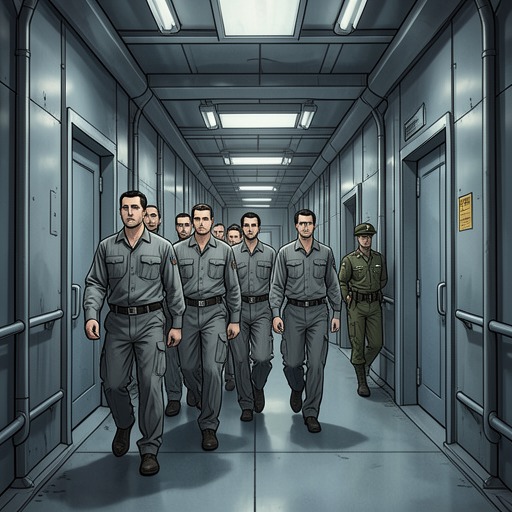
Systema Delenda EstAhruskians are a dispersed population whose members occupy an unusual position in the System: they are recognizable as human, yet they arrive from outside established local histories and can adapt to the System with startling speed. The evidence presents them less as a single organized nation than as a recurring people whose mobility, technical potential, and elite combat ability make them strategically significant. Their appearances repeatedly unsettle the assumptions of System natives, while their human resemblance gives them a dangerous capacity to recognize, conceal, or reproduce the methods associated with Cato.
Identity and Presence
Ahruskians are sufficiently human in appearance that Raine and Leese immediately recognize Lorraine as another human when they encounter her in the Punchy Bastards guildhouse. She is not identical to Cato: her body has a different shape, she has long red hair, and she is considerably more muscular. Nor does she resemble Cato’s golden-bodied cousins. The distinction matters because human presence is rare enough within the System to produce shock, curiosity, and fear rather than ordinary familiarity.
Lorraine identifies herself as an Ahruskian who entered the System only a few years earlier, although by the time of the encounter she has spent a couple of decades within it. Her rapid progress is exceptional even by the standards of an unusually competitive society: she has reached Azoth, a rank very few people attain, and she treats that achievement with cheerful indifference. She cannot give Raine and Leese a sophisticated account of her success. Instead, she says that she simply found herself in the System and proved unusually good at it, as though the System had satisfied an instinct or aptitude she had not previously known she possessed.
The narrative also places Ahruskians in relation to Cato’s family. Morvan is identified as Cato’s cousin and as an Ahruskian, and Muar summons him from the War-Worlds during the Core’s bombardment to ask about Cato’s final weapon. Morvan’s knowledge is incomplete—he knows that his cousin possesses more tools and tricks than Morvan ever encountered—but even this limited family connection gives the gods a possible interpretive key. Ahruskians therefore function not merely as isolated humans but as a population linked, however imperfectly, to the technical and strategic possibilities represented by Cato.
Adaptation to the System
The System does not simply receive Ahruskians as ordinary immigrants. It absorbs them into its own ranks, and their trajectories show how rapidly an outsider can become a formidable System participant. Lorraine’s ascent from recent arrival to Azoth demonstrates the most dramatic version of this adaptation. Her combat style combines fire and ice with water and lightning, and she uses multiple movement Skills with practiced ease. Her aptitude appears instinctive rather than scholarly, but its result is the same: she becomes an elite fighter in a matter of decades.
Her success also complicates Cato’s assumptions about System participants. Leese distinguishes Lorraine from the violent opportunists Cato has described as psychopaths and murderhobos, while Raine recognizes that Lorraine’s abilities could make her an important ally. Because Lorraine is both human and elite, she might possess insight unavailable to System natives and could help Raine and Leese reach other people. Cato has even supplied provisions intended for humans and other species, giving the sisters a practical means of building trust through food as well as ideology. Yet the same human similarity that makes Lorraine potentially valuable also makes her dangerous: she is more likely than an alien species to notice the bodily, communicative, or technological irregularities associated with Cato’s agents.
Ahruskians are consequently treated as a problem of recognition and concealment. Raine and Leese’s combat brains warn them that Lorraine might identify their unusual communication methods or detect influences from Cato’s improvements. The sisters must therefore perform ordinary System identities while assessing whether a fellow human can be trusted. The encounter in Punchy Bastards is not simply a friendly introduction or a sparring opportunity; it is an exchange in which every resemblance carries the possibility of exposure.
Political and Military Importance
The Ahruskians have become a military resource in the conflict surrounding Cato. Muar and Misse discuss the need to direct fresh Alums toward the Crusade, especially toward the frontier, where their service can help resist Cato’s expansion. The Ahruskians present in that struggle are convinced that Cato cannot be defeated by merely losing and retaking worlds in isolation, and Muar agrees that Cato is dangerous but not all-powerful. Their assessment gives the anti-Cato campaign a strategic realism: Cato can be contested, but not through a simple assumption of inevitable victory.
Their political role is equally important because they operate across boundaries that ordinary System institutions cannot easily police. Misse suspects that Cato’s widely separated attacks reveal a coordinated strategy and that frontier gods may have been tempted, intimidated, or otherwise compromised. Muar likewise understands that conflict exposes weaknesses within alliances. In this environment, Ahruskians are not just soldiers; they are potential vectors of information, recruitment, defection, and technological exchange. Their movement between worlds makes them useful to competing powers and difficult to classify as securely belonging to one side.
Muar’s investigation of Cato’s forces illustrates the limits of Ahruskian intelligence. He knows that Cato’s attacks display obvious variations in the number and type of forces deployed, suggesting that Cato is moving or producing his armies by a method the defenders have not identified. The destruction of Cato’s artifacts into metal and sludge, combined with the distances covered by his vessels, prevents the Ahruskians from determining whether portals, teleportation, or some other mechanism is involved. Their uncertainty is not caused by lack of attention; it reflects the deliberate self-erasure of Cato’s machinery and the enormous scale of the war.
Morvan and the Core Assault
During Cato’s final assault on the Core, the Ahruskian connection becomes part of the gods’ emergency response. Muar summons Morvan from the War-Worlds and demands an explanation of the weapon producing continuous light across the Core. Morvan identifies it as something like the particle lances, but larger and operating from a greater distance. He further guesses that it may be a beam using an entire star as fuel, while insisting that the gods themselves should know how to stop it.
Morvan’s answers reveal both the value and the inadequacy of personal knowledge within the Ahruskian community. As Cato’s cousin, he can confirm that Cato has accumulated many devices and capabilities beyond what Morvan ever encountered. But family proximity does not grant complete access to Cato’s methods. Morvan can infer the scale of the weapon without explaining its operation, and his contemptuous refusal to offer the gods a solution leaves them no closer to defense.
Misse responds by erasing Morvan from existence when his information proves insufficient and his defiance becomes intolerable. His death sharply contrasts with the strategic importance initially assigned to his identity. The gods summon him because an Ahruskian relative of Cato might illuminate the attack; they destroy him when he cannot convert that relationship into usable knowledge. The episode exposes the brutal logic of the conflict: Ahruskians are valued as sources of access and expertise, but that value offers no protection once their usefulness ends.
Narrative Significance
Ahruskians embody the System’s unstable boundary between outsider and insider. They can arrive late, master the System’s ranks, and become elite participants, yet their very unfamiliarity makes them politically suspect. Lorraine’s cheerful, instinctive rise shows the System’s capacity to transform an outsider into a champion. Morvan’s forced interrogation shows the opposite possibility: an outsider can be reduced to a disposable informant when larger powers need an explanation for events beyond their control.
Their human resemblance also creates a form of technological and cultural pressure absent from encounters with wholly alien populations. Raine and Leese fear that Lorraine might recognize Cato’s influence precisely because she shares enough of their embodied history to notice what System natives overlook. At the same time, the existence of successful Ahruskians proves that the System’s hierarchy is not closed to newcomers. It can absorb people from elsewhere, reward unusual aptitude, and turn personal talent into military power—while still leaving those people vulnerable to suspicion, exploitation, and erasure.
The Ahruskians therefore stand at the intersection of migration, adaptation, and warfare. They are neither a simple invading population nor a unified faction. They are scattered human outsiders whose exceptional competence can strengthen a guild, complicate Cato’s covert operations, supply the gods with partial intelligence, or become a liability in the instant that a powerful patron decides the information is not enough.